NPTE Exam Tips for Foreign PTs | FREE Review & Exam Support
Passing the NPTE (National Physical Therapy Examination) is the most critical milestone for foreign-educated physical therapists who want to work in the United States.
For Filipino PTs—especially those with a 4-year BSPT degree—the NPTE may feel intimidating, but it is absolutely achievable with the right strategy, preparation, and support.
Quick Summary: NPTE Exam Tips
This guide shares practical NPTE exam tips, proven study techniques, and real-world insights, while highlighting how Grandison Therapy has helped foreign PTs successfully pass the NPTE and secure physical therapy jobs in the USA.
Table of Contents
Why the NPTE is a Make-or-Break Exam for Foreign PTs
The NPTE is not just another licensure exam—it determines whether you can legally practice as a physical therapist in the United States. Regardless of where you earned your degree, you must pass the NPTE to obtain U.S. licensure.
For foreign-educated PTs, the NPTE can be challenging because:
The exam is aligned with U.S. DPT-level practice
Clinical decision-making is emphasized over memorization
Questions are scenario-based and time-pressured
Content may differ from BSPT or non-U.S. curricula
However, thousands of foreign PTs—including Filipino BSPT graduates—pass the NPTE every year.
Understanding the NPTE Exam Format
Before diving into tips, it’s essential to understand the NPTE exam format itself.
NPTE Exam Overview
225 total questions
200 scored questions
50 unscored pretest questions
5 sections (4 hours total testing time)
Passing score determined by scaled scoring
The exam evaluates:
Clinical reasoning
Examination and evaluation
Intervention and prognosis
Professional responsibilities
Understanding this structure helps you prepare strategically rather than emotionally.
Common Challenges Foreign PTs Face in the NPTE
Foreign-educated PTs often share similar obstacles:
1. Transition from Knowledge-Based to Decision-Based Questions
Many BSPT programs focus on theory and technique. The NPTE focuses on what to do next in a clinical scenario.
2. Time Management
The NPTE requires answering complex questions quickly—often faster than foreign PTs are used to.
3. U.S.-Based Clinical Context
Questions assume familiarity with:
U.S. healthcare systems
Direct access practice
Documentation standards
Differential diagnosis
4. Confidence Gaps
Even well-prepared PTs sometimes fail due to anxiety, second-guessing, or lack of exam strategy.
Proven NPTE Exam Tips for Foreign-PTs
These NPTE exam tips are based on what works for foreign-educated PTs—not just theory.
Tip #1: Think Like a U.S. PT, Not a Student
The NPTE tests how you would act as a licensed clinician. Always ask:
Is this safe for the patient?
What should I do first?
What requires referral?
What is within a PT’s scope of practice?
This mindset shift is one of the biggest breakthroughs for foreign PTs.
Tip #2: Master Clinical Scenarios, Not Isolated Facts
Memorization alone will not help you pass.
Focus on:
Case-based questions
Red flags and contraindications
Prioritization of care
Differential diagnosis
This approach mirrors how NPTE questions are written.
Tip #3: Focus on High-Yield Topics
Foreign PTs should prioritize:
Musculoskeletal conditions
Neurology and stroke management
Cardiopulmonary precautions
Differential diagnosis
Ethics and safety
You do not need to know everything—only what is most testable.
Tip #4: Train for Time, Not Just Accuracy
Many NPTE failures happen because of time pressure.
Effective strategies include:
Timed practice exams
Limiting question review time
Practicing educated guessing
Speed and confidence matter.
Tip #5: Learn How to Eliminate Wrong Answers
Often, two answer choices are clearly incorrect.
Train yourself to:
Identify unsafe interventions
Spot out-of-scope actions
Recognize when referral is required
This increases your odds even when unsure.
Tip #6: Understand Red Flags and When to Refer
NPTE heavily tests patient safety.
Always flag:
Sudden neurological changes
Cardiac symptoms
Signs of fracture, infection, or cancer
Unexpected pain patterns
Choosing referral over treatment is often the correct answer.
Tip #7: Follow a Structured Study Plan
Random studying leads to burnout.
A strong NPTE plan includes:
Diagnostic exam
Weekly content goals
Regular full-length practice tests
Review of weak areas
This structure is critical for working PTs and foreign graduates.

NPTE Study Timeline for Foreign PTs
A realistic timeline for foreign PTs:
6-12 months: Ideal for first-time takers
4–5 months: Possible if you have very strong foundation
3 months: High-risk unless guided
Grandison Therapy helps PTs choose the right timeline based on readiness—not pressure.

Grandison Therapy’s Proven Track Record of NPTE Success
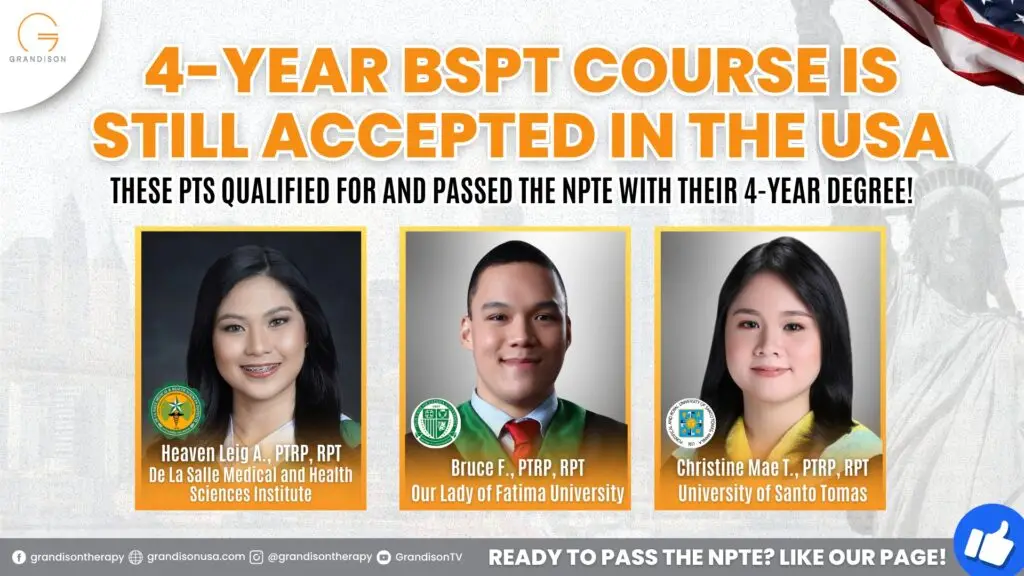
Grandison Therapy has helped foreign-educated PTs—especially Filipino PTs—successfully pass the NPTE and transition into U.S. practice.
BSPT Graduates Who Passed the NPTE
Many Grandison PTs:
Hold a 4-year BSPT degree from the Philippines
Did not initially have a DPT
Passed the NPTE on their first or second attempt
Secured U.S. licensure and employment
This proves that a BSPT degree does not disqualify you from NPTE success when paired with the right strategy.
What Makes Grandison’s NPTE Support Different
1. Filipino-PT-Focused Guidance
Grandison understands:
BSPT curriculum gaps
Credentialing challenges
State board expectations
Advice is tailored—not generic.
2. NPTE Review Strategy Alignment
Rather than pushing one-size-fits-all courses, Grandison helps PTs:
Comprehensive and Intensive Review Programs
- Morning and Evening Classes available for working PTs
Get one on one coaching to focus on weak areas
Avoid unnecessary expenses
3. Exam and Review Sponsorship Support
Qualified PTs may receive:
NPTE exam sponsorship guidance
Review program assistance
Structured timelines aligned with licensure and employment
How NPTE Success Leads to Physical Therapy Jobs in the USA
Passing the NPTE unlocks:
State licensure approval
Employer eligibility
Visa-supported job opportunities
Higher salary offers
NPTE success is the gateway—not the end goal.
Why Choose Grandison Therapy for PT Jobs in the USA
Grandison Therapy goes beyond exam preparation.
1. End-to-End Career Pathway
Support includes:
Credentialing strategy
NPTE readiness
State licensing
Employer placement
Visa-supported jobs
2. Ethical and Transparent Process
Grandison prioritizes:
Honest eligibility assessment
Long-term career success
3. Strong Employer Network
PTs gain access to:
Secured job placement in Skilled Nursing and Rehab facilities across the United States
Stable, growth-oriented roles
4. Filipino-PT-Centered Support
Grandison understands the Filipino PT journey—from BSPT education to U.S. clinical practice.
Frequently Asked Questions (FAQs) about NPTE exam tips and review sponsorship
Is the NPTE harder for foreign PTs?
Can BSPT graduates pass the NPTE?
Do I need a DPT to take the NPTE?
How many times can I take the NPTE?
Does Grandison provide NPTE review classes?

Final Thoughts
Passing the NPTE is challenging—but entirely achievable for foreign-educated PTs, including Filipino BSPT graduates.
With the right NPTE exam tips, structured preparation, and professional guidance, the exam becomes a stepping stone rather than a barrier.
Grandison Therapy’s proven track record of NPTE success shows that foreign PTs can pass the NPTE, secure licensure, and build rewarding careers in the United States.
If your goal is to pass the NPTE and work as a physical therapist in the USA, Grandison Therapy is ready to guide you from exam preparation to employment.