DPT Optional Path for Foreign-PT Jobs in the USA
For many foreign-educated physical therapists—especially Filipino PTs—the question often arises: Is a Doctor of Physical Therapy (DPT) required to work in the United States?
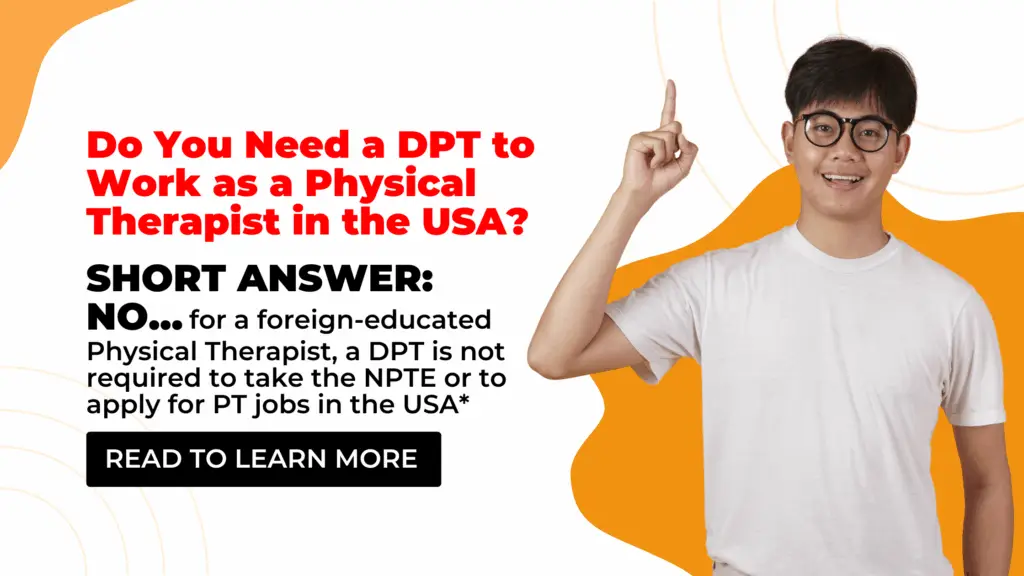
The short answer is not always. However, a DPT can be a powerful optional pathway that opens more doors, resolves credential gaps, and strengthens long-term career growth in the U.S.
Quick Overview
This article breaks down the truth behind the DPT optional path for foreign-PT jobs in the USA, explains when a DPT is actually required, why some PTs still choose to pursue it, where foreign-educated PTs can earn a DPT, and how Grandison Therapy helps internationally educated PTs work legally and successfully in the United States — with or without a DPT.
Table of Contents
Understanding the DPT in the US Context
In the United States, the Doctor of Physical Therapy (DPT) is the entry-level degree for newly trained domestic PTs. Since 2016, all US PT graduates must earn a DPT to sit for licensure.
However, this rule does not automatically apply to foreign-educated physical therapists.
In reality, US licensure is state-based, and foreign PT equivalency is evaluated individually, not by degree title alone.
When Does a Foreign-Educated PT Need a DPT?
A foreign-educated PT may need to pursue a DPT or transitional DPT only under specific circumstances.
1. When a State Board Explicitly Requires DPT-Level Equivalency
Each U.S. state has its own Physical Therapy Board with specific educational requirements. Some states:
Accept equivalent foreign PT education without a DPT
Allow licensure if credential deficiencies are resolved
Require a DPT for licensure, regardless of experience
While New York is well known for mandating a DPT for foreign-educated PTs, other states accepts foreign-PTs with Bachelors Degree only as long as your education is substantially equivalent to that of a Commission on Accreditation in Physical Therapy Education (CAPTE)-accredited physical therapy program.
2. When Credential Evaluation Shows Significant Educational Deficiencies
Foreign PTs must undergo a credential evaluation (e.g., FCCPT, ICD, IERF) to determine if their education is “substantially equivalent” to US standards.
A DPT may be needed if:
Core clinical content is missing
Required lab or clinical hours are insufficient
Coursework does not meet US professional scope expectations
Rather than piecing together multiple bridging courses, some PTs choose a transitional or post-professional DPT to close all gaps at once.
3. When Targeting Highly Competitive States or Employers
While many states like Texas, allow foreign PTs to work without a DPT, certain employers or regions may prefer or prioritize DPT-holders.
This is especially true for:
Academic medical centers
Specialized outpatient clinics
Leadership or teaching roles
Research-oriented facilities
In these cases, a DPT is not legally required — but professionally advantageous.
4. When Planning Long-Term Career Advancement in the USA
Some PTs pursue a DPT to:
Transition into teaching
Move into management or director roles
Strengthen credentials for permanent residency petitions
Expand scope into advanced practice areas
Again, this is a strategic career choice, not a universal requirement.
When a DPT Is NOT Required for Foreign PTs
This is where many foreign PTs — especially Filipino PTs — gain clarity and relief.
A DPT is often not required if:
Your bachelor’s or master’s degree is deemed substantially equivalent
You pass the NPTE
You meet state licensure requirements
You work with employers experienced in hiring foreign PTs
Many foreign-educated PTs currently working in the USA do not hold a US DPT.
Why Take a DPT Anyway? (Optional but Strategic)
Although a DPT is optional for many foreign PTs, some still choose to pursue it — and for good reasons.
1. Expands State Licensure Options
Holding a DPT makes you eligible in more U.S. states, including those with stricter educational requirements. This flexibility matters when:
Visa availability changes
Employers recruit in specific states
You want geographic mobility in the future
2. Stronger Professional Standing
In a market where US-trained PTs all hold DPTs, having the same degree can:
Increase employer confidence
Reduce credential bias
Improve negotiation leverage
3. Career Growth & Leadership Opportunities
A DPT can support advancement into:
Clinical leadership roles
Program development
Education and training positions
Research or specialty practice
4. Immigration & Long-Term Stability
While a DPT is not required for US visas, advanced education can:
Strengthen employment-based green card petitions
Support EB-2 pathways in some cases
Enhance professional profile for long-term settlement
5. Personal Confidence & Professional Identity
For some PTs, earning a DPT is about:
Professional fulfillment
Confidence practicing at the highest level
Aligning with global standards
Where Can Foreign-Educated PTs Take a DPT?
Foreign PTs typically pursue one of the following options:
- Arcadia University
- University of Montana
- List of Other Universities in the USA offering Doctor of Physical Therapy through Distance Learning Only Programs
DPT vs No DPT: Choosing the Right Path
A DPT is optional—but strategic. The right choice depends on:
Target state of licensure
Credential evaluation outcome
Visa pathway
Budget and timeline
Long-term career goals
This is where expert guidance becomes invaluable.

Frequently asked questions about DPT as an optional path for foreign-PT jobs in the USA
Is a DPT required for Filipino PTs to work in the USA?
Is New York the only state that requires a DPT?
Can I work in the USA first and take a DPT later?
Are online or transitional DPT programs accepted?
Does a DPT guarantee higher salary?
How do I know if I really need a DPT?
How Grandison Therapy Helps Foreign-Educated PTs Work in the USA
This is where Grandison Therapy becomes a game-changer.
Grandison Therapy specializes in helping internationally educated PTs—especially Filipino physical therapists—navigate the complex U.S. pathway with clarity and confidence.
Also, Grandison Therapy does not push foreign PTs into unnecessary DPT programs. Instead, it provides a strategy-first, outcome-driven pathway to US employment.
What Grandison Therapy Does Differently
1. Experienced Licensure Strategy
Identifies DPT-optional states
Grandison evaluates your Education background, Credentialing and licensure readiness
Avoids unnecessary coursework
2. Credential Evaluation Guidance
Helps choose the right evaluation agency
Interprets results clearly
Maps next steps accurately
3. NPTE & Licensure Roadmap
- Provides NPTE review and exam sponsorship
Guides you through exam eligibility
Aligns timelines with your NPTE readiness
Reduces costly delays
4. Secured Employment and Visa Sponsorship
Connects PTs with Skilled nursing and Rehab facilities with PT vacancies
Focuses on real PT jobs in the USA, not just theory
Visa-supported job opportunities
Long-term career placements
5. DPT Only When Truly Needed
If a DPT is necessary, Grandison:
Recommends the right type (not the most expensive)
Helps select board-recognized programs
Ensures it actually solves licensure issues
Why This Matters for Filipino PTs
Filipino PTs are:
Highly respected clinically
English-proficient
In demand in rehabilitation settings
Yet many are held back by misinformation about DPT requirements.
With the right guidance, many Filipino PTs can:
Work in the USA without earning a DPT
Start earning sooner
Upgrade credentials later if desired
Final Thoughts: DPT Optional Path for Foreign-PT Jobs in the USA — not mandatory
The Doctor of Physical Therapy is a powerful credential — but it is not a one-size-fits-all requirement for foreign-educated PTs.
The smartest path is not the most expensive one — it’s the most strategic.
If you’re considering PT jobs in the USA and wondering whether a DPT is right for you:
- Don’t guess
- Don’t assume
- Don’t enroll blindly
Talk to experts who understand both licensure and employment.

Ready to Explore Your Best Path to Work in the USA?
Whether you:
Want to work in the USA without a DPT
Need a DPT for a specific state
Are unsure where to start
Grandison Therapy is here to guide you — step by step.
Start your journey today. Build a clear, affordable path to PT jobs in the USA
Connect with Grandison Therapy and turn your international credentials into a US career.